Subterranean termites require continuous ground contact to maintain the moisture levels necessary for survival in the upper Midwest. In Sioux City neighborhoods like Morningside, Leeds, and The North End, older…
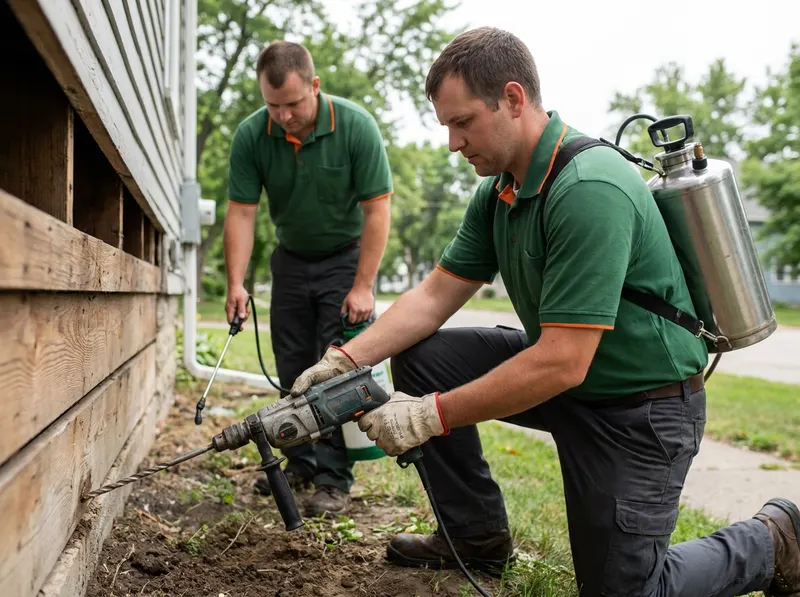
Subterranean termites require continuous ground contact to maintain the moisture levels necessary for survival in the upper Midwest. In Sioux City neighborhoods like Morningside, Leeds, and The North End, older construction with direct wood-to-foundation contact creates primary vulnerability points. Worker termites construct exploratory shelter tubes out of soil and saliva to breach poured concrete or concrete block footings. Left unchecked, a single colony containing 60,000 to several hundred thousand insects hollows out structural framing along the grain, leaving only a thin outer shell of wood veneer and structural weakness in floor joists and wall studs.
Eradication relies on targeted Integrated Pest Management (IPM) rather than indiscriminate surface pesticide application. Liquid non-repellent barrier treatments place an undetectable chemical zone in the soil alongside foundation walls. When foraging worker termites pass through treated soil, they transfer the active ingredient throughout the subterranean colony through grooming and food sharing (trophallaxis), collapsing the reproductive core. In Riverside and Greenville properties bordered by high-water-table areas near the Missouri and Big Sioux river basins, exterior baiting systems provide an alternative, placing slow-acting insect growth regulators directly in the path of foraging insects without requiring high-volume soil drenching.
Decision guidance depends on foundation construction and access limitations. If a structure has a full unfinished basement in Indian Hills or Kelly Park with accessible rim joists, a liquid perimeter application provides immediate exclusion. If a home sits on a monolithic slab with sub-slab plumbing penetrations or features extensive finished basement walls, underground bait stations eliminate the need for disruptive interior tile drilling. The trade-off between the two approaches involves time versus containment: liquid treatments arrest perimeter activity immediately, whereas targeted bait matrixes require 60 to 90 days to achieve full colony collapse through natural feeding cycles.
Every job gets a firm, written price after a free on-site visit.
Tell us about your termite control job in Sioux City and we'll send a clear, written quote, usually the same day.
 Roventra Pest Solutions